
Child care
Every child is entitled to childcare in order to receive individual support. Find out here what types of childcare exist.
Early support for children in child daycare facilities is an important contribution to equal opportunities. Children can build relationships with their peers and benefit from age-appropriate educational programmes. Early childhood educators support and accompany them in this process. Through a variety of offers, activities and different pedagogical approaches, they promote the social, emotional, physical and intellectual development of the child in a comprehensive and individual way.
Alongside the individual support for children provided by childcare services, they are often the most important factor in enabling parents to return to or enter the labour market.
There are many factors that determine where and at what age your child receives childcare. We have listed the different childcare options here:
Day nursery: a place for your children
The word Kindertagesstätte (or Kita for short) is an umbrella term for different types of childcare. In a nursery (Kita), your children will be looked after and cared for by early childhood educators for all or part of the day. Since there is a wide variety of pedagogical approaches, the concepts often differ from one nursery to another. Children aged zero to three are often looked after in crèches (Kinderkrippe). There are also nurseries with groups of different ages. You can visit any nursery in person to find out what is best for you and your child.
Crèches: for children aged 0-3
In Germany, a crèche (Kinderkrippe) is a place where children under the age of three can play with other children of the same age. Since younger children need more attention, they are cared for in smaller groups by qualified early childhood educators. The staff will playfully guide your children as they take their first steps in learning. Age-appropriate meals, naps and outdoor play are all part of the programme. Most day nurseries are flexible about drop-off and pick-up times. Parents’ contribution to the cost of childcare varies according to their income, the region and the organisation running the crèche.
Childminding: flexible and comprehensive care
Childminding (Kindertagespflege) is a special form of childcare. It offers flexible, family-oriented and individual care by a designated childminder and is particularly beneficial for children under the age of three. These childminders are also referred to as Tageseltern (literally “day parents”). Depending on the arrangement, your children may be looked after in the childminder’s home, in your home or elsewhere. In some federal states, several childminders can form a group and look after more than five children together. Such groups, usually called Großtagespflege (large day care centres), give children the opportunity to interact with their peers.
Kindergarten: care for children aged 3-7
The German word for preschool is Kindergarten – you may be familiar with it as it is also used in English. In Germany, kindergartens are for children between the ages of three and seven. Kindergarten usually starts in the morning and ends at lunchtime or in the afternoon, depending on the kindergarten and your preferences. As well as providing lots of fun and games, kindergarten aims to stimulate children’s curiosity. Through simple experiments and playful instruction, they learn about nature and technology while developing their thinking and language skills. Germany also has bilingual kindergartens. Most offer English as a second language, with French and Danish the next most popular languages. As with day nurseries, prices vary widely. Some kindergartens charge no fees at all, while others can cost several hundred euros a year, depending on the parents’ income, the region and the organisation running the kindergarten.
Since 2023, thanks to the Kita Quality Act (KiTa (External link) -Qualitätsgesetz), the federal states have been receiving financial support from the federal government to improve the quality of childcare facilities across the country.
You can also find out about all the benefits to which you are entitled as a family online at the BMBFSFJ’s Family Portal (External link) .
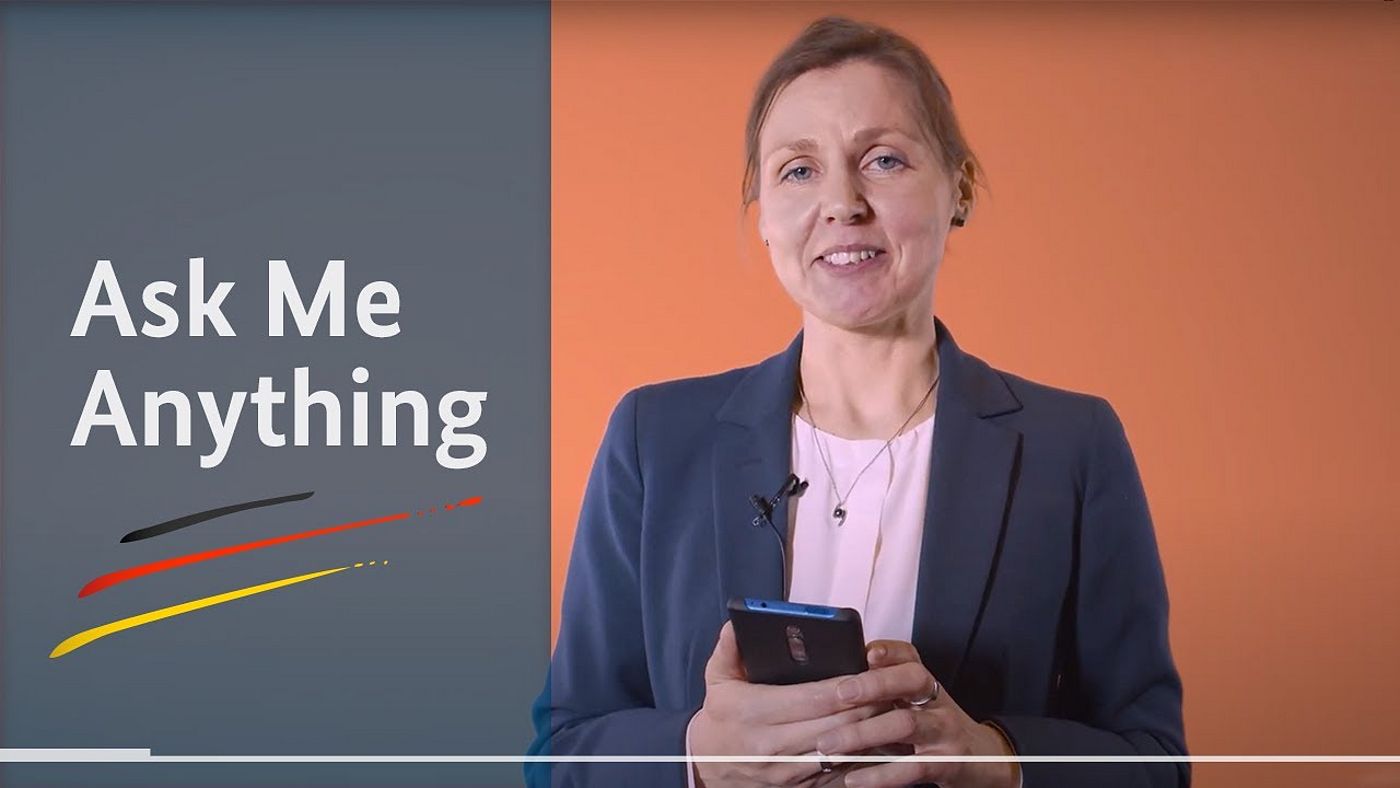
Ask Me Anything - Career and family in Germany
Hello, I am Marina. I am 42 years old and I come from Russia. I have been living in Germany for 20 years now and I have settled in really well. I have a family with two daughters, aged 16 and three.
Where do you currently work, and what do you do there?
The company I currently work for is called Just One Germany GmbH. I work in the IT department, where I am responsible for application support and project management.
How have you managed to balance work and family life over the past years?
It is sometimes a bit of a logistical puzzle that we have to solve as a family every single day, but we do manage it. We decided to use a childminder. That is actually a concept I only know from Germany: trained childminders look after small groups of five to six children every day. The whole thing is also overseen by the city, which means you have to apply to the city for a childminder place, and places are then allocated and approved accordingly. We did this with our youngest daughter, and we were very happy with it.
What do you think of medical care in Germany during pregnancy and childbirth?
I went through both my pregnancies here, and I gave birth here too. The first time, I obviously had less experience. For example, I did not know that you are entitled to a midwife, but that you have to get in touch with one in good time. I did not do that, and only found out shortly before the birth, so I then had to look for a midwife at short notice. Even so, it all worked out really well. Back then, I also stayed in hospital for five days, simply because I was not feeling entirely confident. That went smoothly too. The second time round, I naturally felt more confident, and I was back home just a few hours after the birth, but I still received excellent medical care afterwards. And throughout both pregnancies, I always felt really well looked after.
How long did you take off work?
After my second child, I took the statutory eight weeks of maternity protection period. After that, there is an arrangement called parental leave, and I stayed at home with my child for a further ten months before returning to work.
How do parental leave and parental allowance work in Germany?
When my youngest daughter was ten months old, I started working again, part time, while still on parental leave. On top of that, there is what is known as parental allowance, which gives a young family with a small child a certain level of financial security. This means that once I had applied for parental allowance with the city, I normally received around 65 per cent of my usual salary each month from the city, for a period of twelve months. That gave me the confidence that I could support myself and my family. You can also spread this parental allowance out over a longer period, which is called Elterngeld Plus. And you can share it with your partner or with the child's father, splitting it fifty-fifty. We did it so that I received ten months of parental allowance and he received two months, and in return, he stayed at home full time with our child for those two months. That is how he made it possible for me to return to work completely.
How happy are you with childcare provision (Kita) in Germany?
I am very happy with it. There are different approaches, of course, and you can also choose a private nursery. However, we deliberately chose a council-run nursery, the same one our older daughter used to attend. What really matters is simply how lovingly the children are looked after. And when a child happily goes there every morning and comes home full of new impressions, that really speaks for itself.
Would you like to stay in Germany permanently with your family?
My answer is yes, because for me, Germany is also a country where my children are growing up, where their future lies, and I would really like to help shape that future. So, a clear yes.
Ask Me Anything: career and family in Germany
Legal entitlement to childcare
As of 1 August 2013, children aged one and over have the legal right to be looked after and supported in a nursery or by a childminder. This entitlement, set out in the Child Promotion Act (KiföG) (External link) , does not depend on whether the parents work or not. Children over the age of three have full entitlement to day care until they start school.
Finding the right childcare
-
1 Search
Start your search on the internet. Local government websites usually provide a good overview. Your local Youth Welfare Office (Jugendamt) can provide information on all aspects of childcare.
-
2 Select
Use the family portal (External link) to search for local service providers. Visit your local authorities and different nurseries to find out more about childcare options.
-
3 Register
Once you have found a suitable childcare centre, you can register your child there. Childcare places are scarce in many areas, especially in large cities.
Did you know?
In addition, churches and social institutions often offer supervised playgroups for children (e.g. in family centres). Foreign language playgroups are also available in many cities.
Information on the web
-
-
Federal Employment Agency (BA)
-
Federal Ministry for Education, Family Affairs, Senior Citizens, Women and Youth (BMBFSFJ)

Advice and support
Do you have any questions about visas, jobs or life in Germany? Here you will find the right advice and support services: a hotline, a live chat, an email contact form, webinars and events, as well as in-person advice centres in Germany and abroad.
