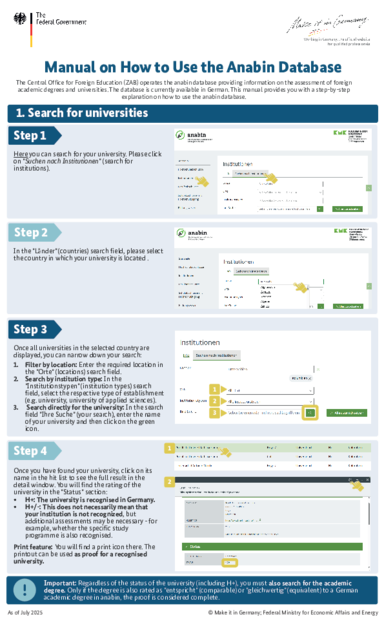
Guide to the anabin database
Use this guide to gain a step-by-step overview of how to use the anabin database.
For some residence titles, your qualifications must be state-recognized in the country of origin. Learn what types of evidence are possible down below.
State recognition in the country of training means that your vocational training or degree course is officially recognised in the country in which you completed it. Proof of state recognition in the country where you completed your training is only relevant for third-country nationals and for certain visa types or residence permits, e.g. the opportunity card (points system).
For example: you completed vocational training as an electronics technician in Morocco. The certificate states: the Moroccan government officially recognises this qualification.
Important: state recognition in the country of training is not the same as formal recognition of the qualification in Germany. The latter is proof that a foreign non-academic vocational qualification is equivalent to a German occupation. Check the visa requirements carefully to see exactly which proof of qualification is required. Please also visit the “Who needs recognition?” section for more information on this topic.
Citizens of EU and EFTA countries do not require state recognition in the country where they completed their vocational training, as they are not subject to visa requirements.
If you come from another country, you needing proof of state recognition in the country of training depends on the visa type you hold.
You will need proof of state recognition in the country of training for the following residence titles:
For other visas allowing you to work as a skilled worker, you do not need proof of recognition in the country of training. For visa types such as the “EU Blue Card”, your qualification must be comparable to a German qualification or recognised in Germany.
The Quick-Check helps you find out which visa options are suitable for you.
The type of evidence you need depends on the nature of your qualification. A distinction is made between:
The Digital Statement on a Foreign Vocational Qualification (DAB) serves as proof of the recognition of the non-academic vocational qualification in the country of training. The following requirements are checked during the procedure:
The DAB can only be applied for in respect of non-academic vocational qualifications – regardless of whether the profession is regulated (e.g. registered nurse) or unregulated (e.g. hotel administrator).
The DAB is a fully digital service and is issued by the Central Office for Foreign Education (ZAB). Detailed information on the procedure, the required documents and the costs can be found on the ZAB website (External link) .
You can have your academic degree assessed through two processes:
1. A positive result on the anabin information portal: proof that your qualification is officially recognised in the country where you studied. As this service is free of charge, please try this option first.
Use this guide to gain a step-by-step overview of how to use the anabin database.
If you do not receive a result here, or if the result is not positive, please use the second option:
2. Statement of Comparability for foreign academic degrees: an official Statement of Comparability for your degree by the Central Office for Foreign Education (ZAB).
Good to know: unlike the DAB, these two forms of evidence for academic degrees can also demonstrate comparability with a German academic degree in a non-regulated profession. This means that they are also suitable, for example, as evidence when applying for an EU Blue Card or for employment as a skilled worker in a non-regulated profession.
You can find out more about anabin and the Statement of Comparability under “Evaluation of Foreign Academic Degrees”.

Do you have any questions about visas, jobs or life in Germany? Here you will find the right advice and support services: a hotline, a live chat, an email contact form, webinars and events, as well as in-person advice centres in Germany and abroad.

Please switch to a modern browser (e.g. Google Chrome, Firefox or Microsoft Edge) in order to enjoy the best user experience.