
Welcome folder in German
Download the welcome folder and add details about your company and your region.
How can I best prepare for the arrival of my new skilled worker in Germany? Here you will find tips and suggestions on how you can support your skilled worker in settling in.
Have you recruited an international skilled worker for your company? Good preparation makes it easier for them to start work and to settle into everyday life in Germany.
A lot is new in the first few weeks: accommodation, dealing with authorities, working procedures and life in a new place. So give your skilled worker guidance early on and appoint dedicated contact persons. That way, they will know from the start who to turn to with questions.

A welcome folder brings together important information for the first period in Germany. It helps your skilled worker find their way around the company, the new area and everyday life more quickly. It also gives your skilled worker practical information to turn to whenever they need it. “Make it in Germany” provides a ready-made welcome folder with relevant, verified information.
Add details about your company and the region to the folder, for example:
If possible, send the completed welcome folder by email before your skilled worker arrives. That way, they can prepare for their arrival and clear up any open questions with you early on. You will find instructions for filling it in further down this page.
Download the welcome folder and add details about your company and your region.
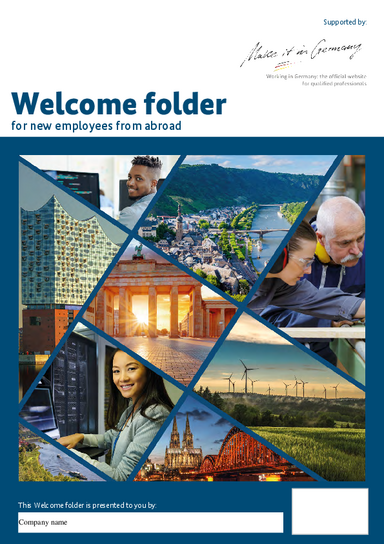
Download the English version of the welcome folder here free of charge.

Download the Spanish version of the welcome folder here free of charge.

The instructions explain the most important functions and show you step by step how to adapt the welcome folder. Please note that the instructions are only available in German.
Many questions come up at the beginning – often not concerning the immediate work environment. So appoint a dedicated contact person in the company – even during the entry process. They can explain to your skilled worker how things work, introduce them to other people and help with everyday questions.
A mentoring or buddy programme can also make the start easier. Experienced employees who know the company and the region well are a good fit for this role. Plan enough time for the preparation and clarify which questions the mentors can help with.
In accordance with Section 45c of the Residence Act (AufenthG) (External link) , you must inform your new skilled worker from a third country in writing that they can receive free advice on labour and social law matters from “Faire Integration (External link) ” (Federal Ministry of Labour and Social Affairs). This must happen no later than their first working day.
Suitable accommodation is an important foundation for starting out in Germany. So, where possible, help your skilled worker find accommodation for the first period.
If your skilled worker has not yet found a permanent home, you can, for example:
When looking for a home, applicants are often asked for an identity document, proof of income or the employment contract and, where applicable, a SCHUFA credit report (SCHUFA is a German credit check showing how reliably a person pays their bills). Tell your skilled worker early on which documents are usually required locally. Also check whether your company can provide temporary housing – for example, as an intermediate landlord or owner. IHK Berlin provides information on the different options in its “Guide to Employee Housing (External link) ” (only available in German).
Skilled workers can find more information in the “Housing and registration” section.
After moving in, there are several administrative steps to take. These can include registering the place of residence, matters at the foreigners authority and questions about health and pension insurance.
Draw up an overview together with your skilled worker:
If needed, help to book appointments or accompany your skilled worker to important appointments – especially if their German is not yet good enough.
Skilled workers from third countries should contact the responsible foreigners authority in good time before their visa or current residence permit expires, and apply for the residence title they need. Which rules apply depends on the individual entry and residence status.
German skills make communication easier at work and in everyday life. Talk to your skilled worker early on about which language skills they need for their tasks and which learning option suits them.
You can, for example:
Colleagues can help too: use clear language and explain company abbreviations and technical terms. It is important that your skilled worker can ask questions without feeling uncomfortable.
For more tips on German courses alongside work and on learning German at the company, see the “German courses for employees” section.
If the family moves to Germany too, their settling in also helps your new skilled worker feel at home quickly. So ask early on where support is needed. This may involve finding a childcare place, a school or a language course for family members.
Nurseries can have waiting lists, so it is worth registering early. Tell your skilled worker about local services as early as possible and pass on contact details of suitable facilities. You can also help with applications or with arranging appointments. Also check whether your company can offer a subsidy towards childcare costs.
You can find information on the school and childcare system in the “Family life in Germany” section. For more information on childminding, see the Bundesverband für Kindertagespflege (External link) (Federal Association for Childminding).
A German mobile phone number and mobile internet access make many steps easier after arrival – from navigation to booking appointments. Tell your skilled worker about suitable plans and, if needed, help them with buying one or signing a contract.
Which proof is required depends on the provider and the chosen plan. So your skilled worker should check the requirements with the provider in advance.

Receive advice on recruiting skilled workers from abroad. Our experts will gladly help you.

Please switch to a modern browser (e.g. Google Chrome, Firefox or Microsoft Edge) in order to enjoy the best user experience.

