Students from abroad
Foreign students who complete their studies in Germany are a valuable addition to your company. Find out here how you can employ and integrate these students in your company while they are still studying.
Foreign students at German universities are a group with high potential. In addition to their professional qualifications, they are usually already familiar with the cultural side of Germany as well as the language. Moreover, you can save time when recruiting foreign students because they are already inside the country.
Employment of foreign students during their studies
Students from third countries who are in possession of a residence permit for studying (Section 16b of the Residence Act [AufenthG]) (External link) are allowed to work up to 140 full days or 280 half-days a year without the approval of the Federal Employment Agency (BA). The following rules apply:
- Working hours of up to four hours count as a half-day, otherwise they count as a full day.
- Alternatively, students from third countries as well as those from EU and EFTA member states are allowed to work up to 20 hours per week during the lecture period, just like German students. During the semester break, they are allowed to earn money unrestrictedly.
For student jobs, e.g. student assistants at higher education institutions or jobs in close relation to the studies, this rule does not apply. These jobs can be pursued unrestrictedly in regard to the working hours.
Apart from this, according to Section 16b (4) of the Residence Act (AufenthG) (External link) , there are alternative prospects for international students from third countries after or even before graduating:
- Working as a skilled worker: on special conditions, a job offer as a skilled worker can already be accepted during the stay as a student. This entails a change of residence permit to a residence permit for qualified employment without having to graduate prior to that. In this context, it is important that the employment is not temporary. You can obtain detailed information on this topic at the competent foreigners authority.
- Vocational training instead of studying: instead of studying, completing qualified vocational training is also an option. In order to start vocational training, the residence permit must be changed according to the new purpose. A residence permit to complete vocational training requires an assessment of the Federal Employment Agency (BA) and additional special requirements must be met. You can find further information on this residence permit in the “Visa for vocational training” section. If you wish to receive detailed information, please contact the competent foreigners authority.
Employment after successful completion of studies in Germany
After completing their studies in Germany, foreign graduates can immediately take up qualified employment. In order to look for a job in Germany, they will usually receive a residence permit valid for up to 18 months.
Campus-Initiative for International Talents of the DAAD
The DAAD's “Campus Initiative for International Talents” supports German universities to better prepare international students and graduates for the German labour market. This includes the programmes “FIT” (Promotion of international talents for integration into studies and the labour market) and “Profi plus” (Academic Training for the German Labour Market). There are more than 100 projects in total at many different universities. The offers range from language courses to mentoring programmes. As a company, you can get in touch with a participating university in your region to meet international talents. You can find all the programmes and universities in this interactive map (External link) .
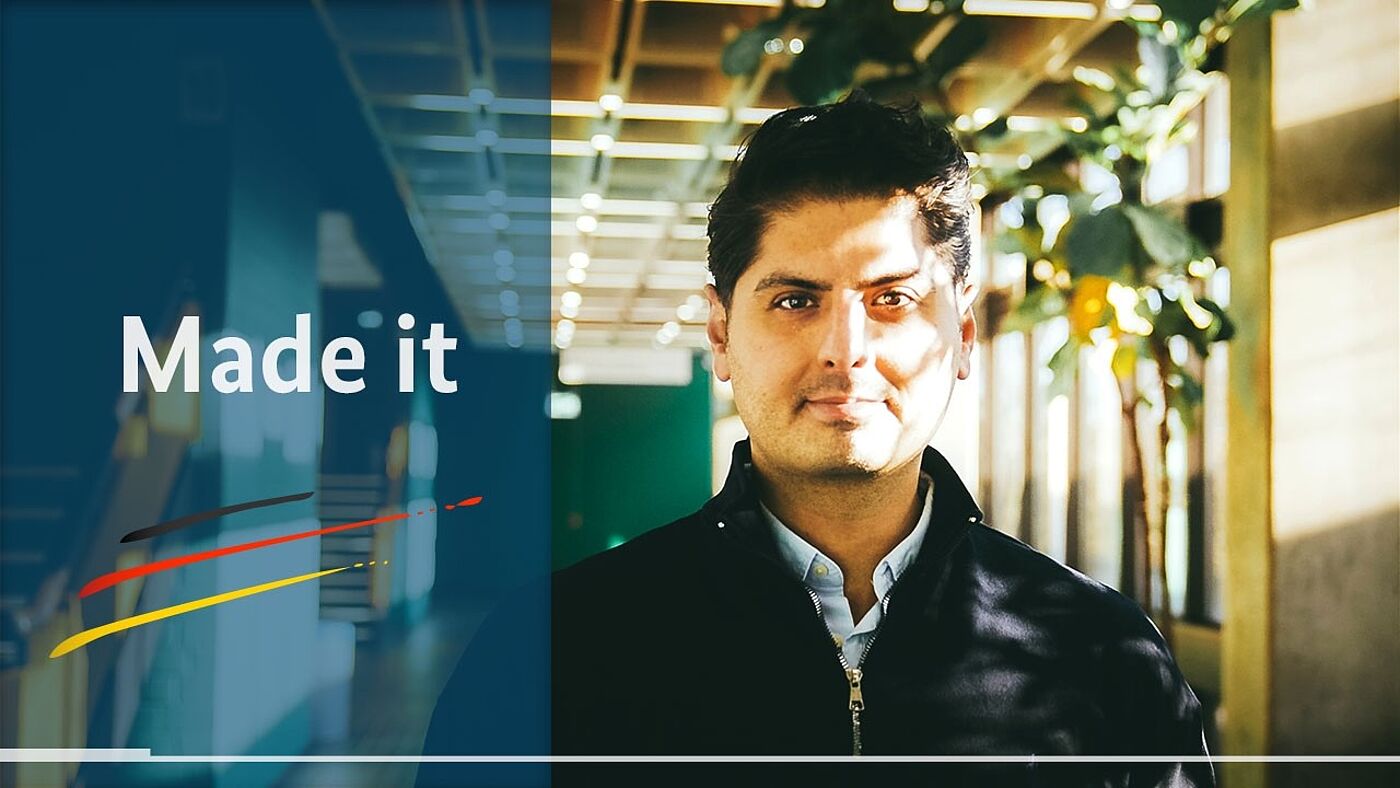
From Studies to a Job in Germany: Success Story of an International Student
I have been living in Germany for seven years.I completed my bachelor's degree in civil engineering in Iran. Then I worked self-employed for three years and then I came to Germany. Now I work as an energy efficiency expert and it was a long journey and also a tough one, but it was worth it.
My name is Sina. I come from Iran, I am 32 years old and I did my master's in Green Building Engineering at TH Köln.
At the very beginning, I had just finished my bachelor's degree, a friend of mine wanted to go to Germany and Austria and had taken a German course. He told me "Sina, you speak English—if you want, you can simply learn a new language. And if you're interested, you can of course also go to Germany to continue studying."
I'm the kind of person who has to plan everything. That means I definitely had to know beforehand: What about the visa? What about the work permit? For example, is it expensive to study here? How does finding an apartment work? All of these topics play a big role, of course. But sometimes there are surprises too.
I was really happy, I wanted to start university life and experience a bit of uni life here in Germany, and then COVID happened. And that was really bad luck for me.
But then I was saved by living in a shared flat. I was lucky. I found a shared flat with two roommates who were both German. I was able to improve my German and for me that opportunity was also an open door to the culture, to life in Germany and also to learning the language. To speak German, you just can't be afraid, you simply have to do it. And at some point you get into it and you keep learning better and better. Just do it!
I think Sina is simply someone who dares to speak. And from the very beginning we spoke German with each other. For us that was never a negative topic, but rather something that was always impressive to us, how quickly Sina learned and made progress.
I came to Germany as a student, meaning on a student visa. And for that you need a few requirements: One of the most important is financing. You have to prove it somehow, either with a blocked account or with something else. And of course I did that too. I also had various side jobs and at some point I said that I'd like to get into my field. And I applied, just like everyone else, to job postings online. And that's how I ended up at INDICAMUS. We do energy-efficient refurbishments of buildings and I also advise homeowners' associations.
We noticed early on that Sina brings not only professional expertise, but is also extremely good at teamwork. What we really value here as a young team is that we grow together. And Sina has since moved up into a leading role and has become an important part of our company.
I'm really proud that I do everything in German. And I'm also really proud that I do work that truly makes sense. And I have my job and my colleagues, and it's really fun working with them. That's why I'd say Germany means a lot to me and I almost count it as a second home.
One of the difficulties, I'd say, is extending your visa here. And there is a lot of bureaucracy in Germany. We all know that. And that's something that could maybe be improved. But in the end it worked out, and it was worth it that I'm now at INDICAMUS.
I'd say deciding from the outside whether you can work here is not that easy. For me it was like this: I first started studying here, and then I realized: "Yes, I can also imagine working here." And it worked out well. Here I got a feel for German culture. How does it work? Is it something for me or not? And then just try things out step by step. And at some point it worked, and then I saw: "It's for me."
The most important thing here is to speak German. And I would definitely recommend: Go up to people. Join in with everything: parties, after-work beers. Be open to simply having fun with people, and at the same time you can also get to know this culture.
I'd just be open and honest and say: Yes, it's difficult. But in the end it's worth it!
Video: From studying to working in Germany – a success story



Information on the web
-
-
KOFA (Centre of Excellence for securing a supply of qualified professionals)

Do you have any questions?
Receive advice on recruiting skilled workers from abroad. Our experts will gladly help you.