What types of visa are available to me - Graphic
In this graphic you will find a simplified overview of different types of visas for working in Germany.


Do I need a visa to work, study, or undertake vocational training in Germany? Here you can find out everything you need to know about visa requirements, the visa application process, and residence titles.
First, a few general points: the necessity for a visa for Germany depends on your nationality and the purpose of your visit to Germany.
Are you not a citizen of the EU or an EFTA country and would like to work, study or do vocational training in Germany?
There are exceptions to this visa requirement for nationals of so-called “privileged countries”. Depending on the purpose of their stay, they may enter Germany without a visa. You can find the exceptions here:
The infographic “Entry and employment of privileged citizens” also provides an overview of these regulations. Further information on visa requirements and visa-free travel is available on the Federal Foreign Office’s website (External link) .
If you hold more than one nationality, you should first check whether you are eligible for privileged entry under any of these nationalities.
If you are a citizen of the EU or an EFTA country (Iceland, Liechtenstein, Norway, Switzerland), freedom of movement applies to you:
Before applying for any visa (regardless of the type), you must check whether you meet the basic requirements for being granted a residence title (Section 5(1) of the Residence Act [AufenthG] (External link) ):
In addition to these basic requirements, you must also comply with the specific requirements relating to the purpose of your entry and stay. Depending on why you are coming to Germany – for example, to work or study – you must meet different requirements (such as German language skills or a degree) for your visa. You can find out what you need to bear in mind in the “Types of Visa” section.
No, you do not need a visa sponsorship from an employer to enter Germany for work. If you are required to have a visa, you will usually apply for it yourself at the relevant German mission abroad. Please refer to the "Types of visa" section for more information on the relevant application requirements.
In this graphic you will find a simplified overview of different types of visas for working in Germany.
If you meet all the visa requirements, you will need to prepare the documents for your visa application. You can usually find the list of required documents on the website of the German Embassy in your country of residence. To do this, look under "Contacts worldwide" to find the embassy responsible for your case.
You can submit your visa application online via the Federal Foreign Office’s Consular Services Portal (External link) . If it is not yet possible to apply for a visa via the Consular Services Portal in your country, please use the digital Videx application (External link) . Complete the online form and submit it, together with the required documents, to the German embassy responsible for your case.
The waiting time for an appointment at the German embassy varies depending on the location. You should therefore allow plenty of time for the appointment request and the processing time.
The fee for an entry visa is 75 euros. This applies to all visas for a long-term stay in Germany. The fee is non-refundable if your visa application is refused.
In certain cases, the fees may be reduced or you may not have to pay any fees at all. For example, spouses and children of German nationals do not have to pay any fees. This also applies to people who receive a publicly funded scholarship for their stay in Germany. You can find out more details from the relevant German mission abroad or from the Federal Foreign Office (External link) .
Have you already found an employer and are due to start work soon? Your future employer can speed up the process from Germany. Please advise them about the fast-track procedure for skilled workers before you book an appointment at the embassy.
Has your visa been granted? You can now start preparing for your trip to Germany.
Make sure you bring all your personal documents with you, both the originals and digital copies: for example, your birth certificate, school leaving certificates and qualification documents, and, if applicable, your driving licence and marriage certificate.
Remember that you will need health insurance in Germany from day one. Proof of insurance will be required at the latest when you collect your visa from the German embassy.
Find out about your new home before you travel. In the “Living in Germany” section, you’ll find information on key areas of life to help you settle in: finding accommodation, language courses and more.
A warm welcome to Germany! Your visa is usually valid for up to twelve months. Within this period, you must apply for a residence permit so that you can stay in Germany on a long-term basis. Immediately after your arrival, contact the competent foreigners authority (External link) and find out which documents you need to submit your application. Then make an appointment to apply for the relevant residence permit.

This graphic outlines the main steps involved in accessing the German labour market, including the different visa requirements and obtaining a residence permit after arrival.
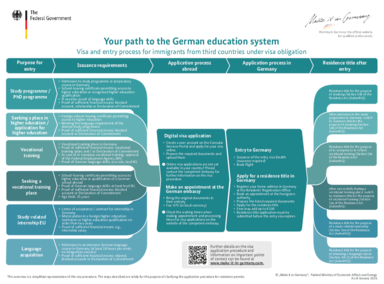
This graphic illustrates the pathway into the German education system, covering everything from the visa requirements to the residence permits after arrival.
Receive advice on your opportunities to work and live in Germany. Expert support is offered for questions regarding job search, visas, recognition of qualifications and learning German.
Click the icons in the bar below to discover all contact options.


Please switch to a modern browser (e.g. Google Chrome, Firefox or Microsoft Edge) in order to enjoy the best user experience.
How do you search for information and advice? Take part in a short, anonymous survey and help improve "Make it in Germany".