
Hiring Skilled Workers from Third Countries: Entry and Employment Step by Step

Are you looking to hire a skilled worker from a third country that requires a visa? This overview shows you the steps involved, from checking the requirements through to the start of work and long-term employment. The rules that apply depend on the individual case, in particular on nationality, occupation, qualification and the planned residence permit.

First, use the Quick Check for employers to find out which route is right for your future employee. Nationals of EU and EFTA countries benefit from the freedom of movement for workers. Nationals of certain other countries can enter without a visa and apply for their residence permit in Germany.

1. What requirements apply for recruitment?

The requirements for hiring depend on the entry route, the occupation and the planned employment. At the outset, clarify what tasks the employee will carry out and when they can start. 

First, clarify the following:

  • Nationality and residence status of the employee
  • Possibility of recognition, a certificate evaluation or further qualification
  • Statutory minimum salary requirements
  • Planned start date
  • Required language skills

If you have questions, the Employer Service of the Federal Employment Agency, the local immigration authorities and free local advice centres for employers (database only available in German) in your area can help.

2. When is recognition or other proof of qualification required?

The proof required for the visa depends on the planned residence permit. For regulated professions, such as certain healthcare professions, you must also check which licence to practise is required. In other cases, recognition, a certificate evaluation or other proof may be required or helpful. There is no blanket rule that applies to every occupation and entry route. 

Check the specific route, the responsible authority and any further qualification that may be needed. For details, see “Recognition of foreign qualifications”.

Now clarify the following:

  • Is the occupation regulated or unregulated?
  • What qualification does the employee have?
  • Which authority is responsible for the assessment?
  • Does the employee still need to make up any missing knowledge or qualifications?
  • What documents are needed for the procedure?

3. What information should the job offer include for the visa application?

The employee needs a specific job offer; an employment contract often serves as proof. Clearly describe the role, place of work, working hours, pay and planned start date. The details must match the actual employment and the documents submitted as part of the visa procedure. For the EU Blue Card, the role must match the employee's qualification.

In addition, fill in the “Declaration of Employment” in full and sign it. Also check whether a minimum salary applies to the intended residence permit and whether the Federal Employment Agency must approve the employment. If you want the requirements for labour market approval to be checked before the visa application, prior approval from the Federal Employment Agency may be an option. For more information, see “Approval from the Federal Employment Agency”.

What visas are available to my skilled worker?

This infographic serves as a guide to visa options for Germany, with a focus on working. Based on the individual circumstances of your skilled worker, the infographic guides you step by step towards the most suitable options.

4. How can you assist with the visa application process?

The employee submits the visa application at the relevant German mission abroad. Ask together about the documents required there and provide your documents in good time. Allow a time buffer for the start date, as procedures and appointment scheduling can take different lengths of time.

As an employer, you can make the process easier by providing all required documents in full and on time. Appoint a single point of contact for the entire visa process so that you can respond promptly to queries from the mission abroad and submit any missing documents.

Tip: With the fast-track procedure for skilled workers, you as the employer can initiate and speed up the entry procedure at the relevant immigration authority, provided the employee has given you power of attorney. 

5. What obligations apply before and during employment?

As an employer, you must ensure that the employee is employed only within the scope of their valid residence permit. Changes to the employment relationship can affect residence status. You also have further obligations as an employer:

  • Keep a copy of the employee's current residence permit for the duration of the employment and keep an eye on any time limits.
  • No later than the employee's first day of work, inform in writing any skilled worker recruited from a third country about the free labour and social law advice provided by “Faire Integration”, and give the contact details of the advice centre closest to the workplace. If the employee was recruited through a placement agency, this duty to inform may instead lie with the agency. 
  • If the employment ends early, inform the relevant immigration authority within four weeks of becoming aware of the termination.

6. What needs to be organised after the skilled worker has arrived?

Find out early what the employee needs for the first days and weeks, and support them throughout.

This is important now: 

  • Welcome and first day at work
  • Registering your place of residence
  • Appointment at the foreigners authority to apply for the residence permit
  • Health insurance and social security
  • Tax identification number and payroll
  • Bank account and payments
  • Accommodation and, if necessary, finding a flat

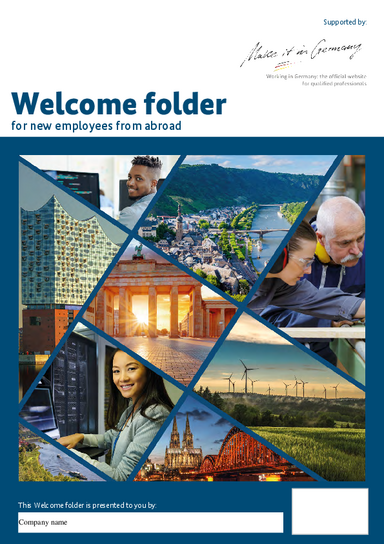
The “Make it in Germany” welcome folder supports your new employee in getting started at your company.

Welcome folder

Here you will find the welcome folder for international skilled workers in English.

7. How can I achieve successful long-term cooperation?

Support your employee in settling into your company and life in Germany. A dedicated point of contact, structured induction and suitable language and training opportunities make the start easier and encourage long-term loyalty to your company.

Keep an eye on the validity of the residence permit and talk early about a possible extension or change. 

Tip: Regional Welcome Centres and other advice centres support companies and international skilled workers with questions about arrival, integration and long-term employment.

Consultant sitting in front of a computer screen in an office with other people in the background.

Do you have any questions?

Receive advice on recruiting skilled workers from abroad. Our experts will gladly help you. 

Get in touch

Success through diversity: International professionals enrich companies and secure competitive advantages.