Work, Salary & Social Security
What can you earn in Germany? Which deductions are taken from your salary, and how high is the cost of living? Here you will find an overview of salaries, working conditions, taxes, social security, and everyday expenses.
Salary in Germany: gross, net and deductions
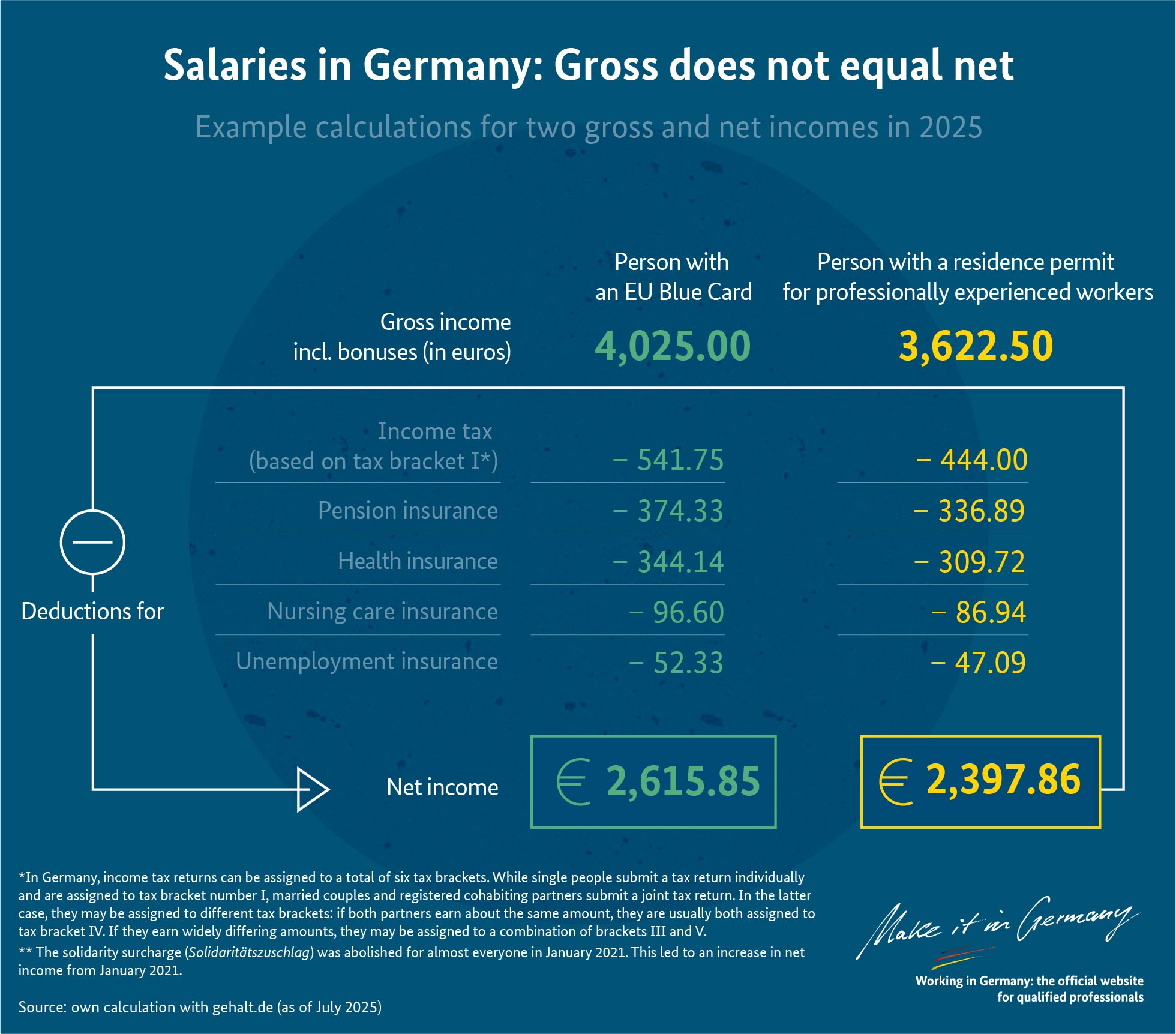
If you work in Germany and are subject to compulsory social insurance, your employment contract usually states your gross salary. This is your salary before tax and social security contributions are deducted. The amount paid into your account after these deductions is called your net salary. In other words, gross pay is not the same as net pay.
If your employment is subject to compulsory social insurance, your employer automatically deducts income tax and statutory social security contributions from your gross salary. You do not need to pay these contributions to the tax office yourself. As a rule, your employer also covers part of the social security contributions. The advantage is that your social security contributions provide you with financial protection in case of unemployment, illness, long-term care needs or old age.
The amount of the deductions depends, among other things, on your income, tax bracket, marital status, federal state and health insurance fund. You can see the individual amounts on your payslip every month. You can use the wage and income tax calculator (External link) from the Federal Ministry of Finance to calculate your net pay. Please note that the calculator is only available in German.
What can you earn in Germany?
The “Entgeltatlas” (External link) (salary atlas) from the Federal Employment Agency gives you an idea of earning potential in different occupations and regions. The figures refer to gross salaries. Please note that the “Entgeltatlas” is only available in German.
These are the taxes you pay as an employee in Germany
The most important tax for employees is income tax on wages. Your employer pays this to the tax office every month as income tax withheld from your salary. The amount of tax withheld depends mainly on your income and your tax bracket (External link) . As a general rule, the higher your income, the more tax you pay. The income tax rate ranges from 14 to 45 per cent of your wages.
Your tax bracket affects how much tax is deducted from your salary each month, while the final amount of tax you owe is only determined with your income tax return. Germany has six different tax brackets in total.
Which tax bracket you are placed in depends on several factors:
- Marital status: Are you married, single, divorced, or in a registered same-sex civil partnership? If you are married: if you got married abroad, your marriage is not automatically recognised in Germany. Please contact the registry office responsible for your place of residence in Germany to find out how to register your foreign marriage certificate there.
- Does your partner receive a salary? If so, is their salary higher or lower than yours?
- Do you have children? Are you raising them alone or together with a partner or spouse?
- Do you have another job for which you receive a salary?
If you are a member of a church, you may also have to pay church tax.
What is a tax return?
At the end of a calendar year, you can submit an income tax return so that the tax office can check whether you have paid too much tax. In the income tax return, you state, among other things, how much you earned in the previous year and how much income tax your employer paid to the tax office on your behalf.
In certain cases, submitting a tax return is compulsory, for example if you work for several employers. In many other cases, it is voluntary. A voluntary tax return can be worthwhile if you have paid too much tax or can claim work-related expenses. This way, you can get money back from the state.
You can complete your tax return yourself using the tax office's forms or the ELSTER (External link) programme. Alternatively, you can use apps or tax software on your computer, contact an income tax assistance association, or hire a tax adviser.
The Federal Central Tax Office (External link) also offers further helpful information, including materials in English.
When you move to Germany for the first time and register with the residents' registration office, you automatically receive your eleven-digit tax identification number, or tax ID, by post from the Federal Central Tax Office. You need to give this number to your employer so that they can deduct income tax from your salary.
Your tax ID remains valid for your entire life. If you have already worked in Germany before and received a tax ID, you must continue to use the same number. If you no longer know your tax ID, you can request it from your local tax office.
Social security in Germany
Statutory social security provides you with financial protection if you become ill, need long-term care, become unemployed, or retire. If your employment is subject to compulsory social insurance, you are usually automatically covered in the main branches of social security. It consists of the following:
- The statutory health insurance: it covers the costs of doctor's visits as well as many medicines and treatments.
- The statutory long-term care insurance: it provides basic cover in case you permanently need care due to illness. This mostly affects people in old age.
- The statutory pension insurance: it pays employees a statutory pension after they retire. The amount of the pension depends mainly on their income and the number of years they have worked in Germany.
- The statutory accident insurance: it covers the costs of medical treatment and reintegration into working life after a workplace accident or in cases of occupational illness.
- The statutory unemployment insurance: it pays unemployed people an income for a certain period if certain conditions are met. As a rule, you must have been insured for at least one year within the last two years and be actively looking for work.
For social security, you pay a certain percentage of your salary, which is automatically deducted from your gross pay and paid into the insurance system. Your employer also pays a share. As an employee, you are automatically a member of the pension, long-term care, accident and unemployment insurance schemes. For health insurance, depending on your situation, you can choose between different health insurance funds.
What is the social security card and the social security number?
As an employee, you receive a social security card ("Versicherungsnummernachweis") showing your social security number. This document used to be called “Sozialversicherungsausweis”. Give the number to your employer and keep the card in a safe place. Your social security number stays the same even if you change employer. If you lose the card, you can request a replacement from the Deutsche Rentenversicherung (Statutory German Pension Insurance).
Working hours, paid holiday entitlement and public holidays
Compared internationally, Germany is one of the countries with relatively short working hours and many days of paid holiday entitlement and public holidays. Your specific working hours and holiday entitlement are set out in your employment contract or result from a collective agreement.
Limits on working hours, as well as requirements for breaks and rest periods, are set out by law. Your statutory minimum holiday entitlement depends on the number of days you work per week. You generally need to request holiday from your employer and have it approved. The public holidays that apply to you depend on the federal state in which you work. Work generally stops on these days, although there are exceptions for certain activities and sectors.
What is the cost of living in Germany?
How much money you need for everyday life depends on where you live, the size of your household and your personal lifestyle. Most of your expenses go towards rent. In large cities, housing is often more expensive than in rural areas or smaller towns. If you live in a hall of residence, for example during vocational training or academic studies, you usually pay less than for your own flat or a room on the private housing market. In addition to the basic rent, there are additional costs, for example for heating, water and electricity.
Further regular expenses arise for food, transport, leisure and communication. The amount depends on your personal lifestyle. At the start of your life in Germany, you may also have one-off costs, for example for furniture or household items.
Before you move, it is therefore worth finding out specifically about the cost of living at your future place of residence. Regional rent indexes can help you to better estimate housing costs. You can find current data on consumer spending from the Federal Statistical Office (External link) .




Information on the web
-
-
Federal Ministry of the Interior
-
European Commission
-
International Organization for Migration | IOM, UN Migration
-
German Pension Insurance
-
Top-Level Association of Statutory Health Insurance Providers
-
Handbook Germany

Do you have any questions?
Receive advice on your opportunities to work and live in Germany. Expert support is offered for questions regarding job search, visas, recognition of qualifications and learning German.
