

Do I need to know German?
Your everday life in Germany will be easier once you learn German. Find out here why German language skills are important.
Learning German is one of the most important steps you can take to prepare for life in Germany. It will help you settle in more quickly and make it easier for you to find new friends.
For some purposes, such as work or study, it may even be necessary for you to demonstrate a certain level of German. Proof of a particular level of German is also often required when applying for a visa:
German language skills for certain professions
Healthcare professions: If you plan to work in the health sector in Germany, e.g. as a nurse or doctor, knowledge of the German language is essential. Level B1 or B2 of the Common European Framework of Reference for Languages (CEFR) is required, depending on the federal state in which you wish to work.
Regulated professions: You will need to obtain recognition in order to practise a regulated profession in Germany, such as teaching or law. These and many other regulated professions also require a knowledge of German. Further information on the recognition procedure and language certificates can be found on the "Anerkennung in Deutschland (External link) " portal, and personal advice can be obtained from the Service Center for Professional Recognition (ZSBA) (External link) .
German for students and trainees
If you are applying for a German-language degree programme in Germany, you will need to prove that you have the language skills required by the higher education institution. As a rule, prospective trainees must also be able to speak German at the level required to start their training in Germany. You can find more information on this in the “Study” or “Training” section.
German language skills as a visa requirement
A certain level of German may be required to apply for a visa. You need to have a B1 level of German to obtain a visa for the purpose of seeking vocational training. German language skills at level B1 are required to obtain a visa for vocational training. A minimum A2 level is usually required to obtain a visa for the recognition of foreign professional qualifications.
Please make sure that you only accept language course services which, upon completion, will issue a language certificate meeting the standards of the so-called ALTE-certified examination providers. Language certificates of other services are not recognised in the visa procedure. The following providers are currently approved, regardless of the examination location:
- Goethe-Institut e.V.
- telc GmbH
- Austrian Language Diploma (ÖSD)
- TestDaF-Institut e.V. (Institute of Fernuniversität Hagen and Ruhr University Bochum; language examination level only level B2 and higher [CEFR])
- ECL exam centres (examination conducted by AFU GmbH)
- German Language Diploma of the Standing Conference of the Ministers of Education and Cultural Affairs (DSD)
- For international (prospective) students in Germany: German language exam for university entrance (DSH) at a German university
Read more about the requirements for each type of visa in the “Visa” section.
Required German language skills depending on the type of visa
| Type of visa | Required German language skills according to the Common European Framework of Reference for Languages (CEFR) |
| Work visa for qualified professionals | No legal requirement |
| EU Blue Card | No legal requirement |
| Opportunity card (points system) | German language skills at least at level A1 or English language skills at least at level B2 |
| Visa for the recognition of foreign qualifications | German language skills at least at level A2 |
| Visa for employment within the framework of a recognition partnership | German language skills at least at level A2 |
| Work visa for professionally experienced workers (incl. IT specialists) | No legal requirement |
| Visa for vocational training | German language skills at least at level B1 |
| Visa for seeking a vocational training place | German language skills at least at level B1 |
| Visa for self-employment | No legal requirement |
| Visa for studying | As a general rule, German language skills at least at level B2 (depending on the study programme) |
| Visa for seeking a place in higher education | Language requirements of the desired study programme |
| Visa for research | No legal requirement |
| Visa for language acquisition | No legal requirement |
| Visa for a study-related internship EU | No legal requirement |
Please note: The above information on language requirements is based on the legal requirements in the Residence Act. Other language requirements may apply as part of any necessary recognition procedure or the examination procedure at the German missions abroad.
Settle into your job more easily with German skills
Even if you do not need to prove your German language skills for your job, learning German in advance is a sign of your commitment. Since people often speak differently in the workplace than they do in everyday life, being aware of linguistic and cultural differences and knowing specific terminology will help you deal with these situations more effectively. Vocational language courses (External link) are a good way to prepare for the world of work.
Language skills to receive the Opportunity Card
You generally have to prove your language skills for the opportunity card. You must either have German language skills at level A1 of the CEFR or English language skills at level B2 of the CEFR. Proof of language skills is not necessary if you already have a non-academic vocational or academic qualification recognised in Germany.
If you are looking for a job in Germany, good German language skills will improve your chances on the labour market. Regardless of legal requirements, many employers expect their applicants to have good language skills.
German for spouses
German for spouses: German language skills are important to help you integrate quickly into working life and society. Your partner is also likely to feel more at home in Germany if all members of your family can speak at least some German. Nevertheless, if you are applying for a visa for your spouse or children to join you in Germany, you do not need to provide evidence of their language skills if you have one of the following residence permits:
- EU Blue Card (Section 18g of the Residence Act [(AufenthG]))
- ICT Card and Mobile ICT Card (Sections 19, 19a AufenthG)
- Residence permit for skilled workers (Section 18a AufenthG or Section 18b AufenthG)
- Settlement permit for highly skilled workers (Section 18c para. 3(3) AufenthG)
- Residence permit for research purposes and mobile researchers (Sections 18d, 18f AufenthG)
- Residence permit for other employment purposes; civil servants (Section 19c AufenthG)
- Residence permit for the purpose of self-employment (Section 21 AufenthG)
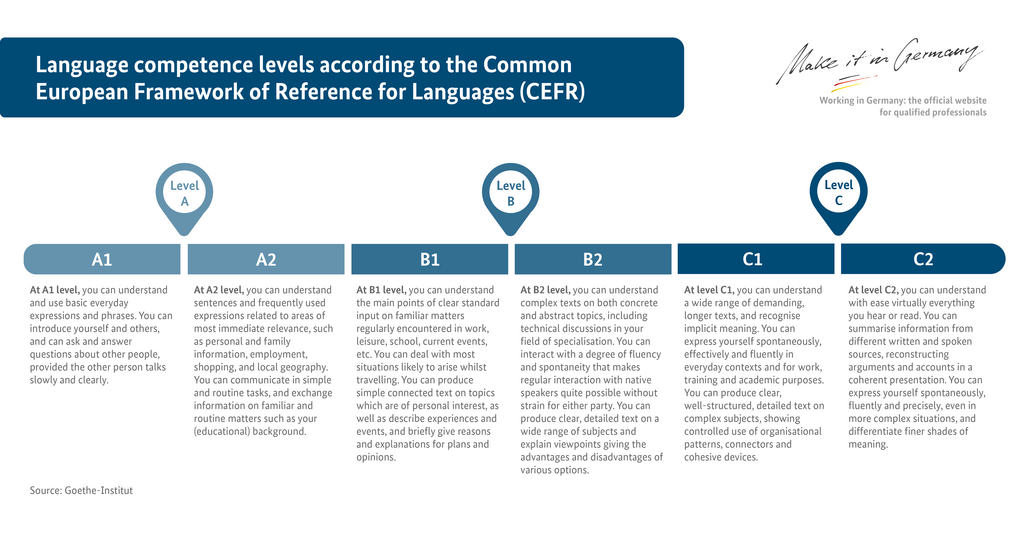
How is German language proficiency measured?
Your German skills are usually assessed on the basis of the Common European Framework of Reference for Languages (CEFR). The CEFR distinguishes between six levels of language competence, which describe what learners of a foreign language are able to express and understand at each level.
How can I prove my German language skills?
If you need to prove your language skills for your visa application, you generally need an official language certificate from a recognised institution. The best-known providers include the Goethe-Institut (External link) and telc (External link) . These certificates comply with the levels of the Common European Framework of Reference for Languages (CEFR), such as A1, B1 or C1 - depending on the requirements for your visa.
Another useful service is “Deine Deutschprüfung (External link) ” (Your German exam) from Deutsche Welle. It provides comprehensive information on different exams for learners of German who want to officially prove their language skills.



Information on the web
- Goethe-Institut Why learn German?
- German Academic Exchange Service Information about language courses, exams and placement tests
- telc gGmbH Language exams and certificates
Do you have any questions?
Receive advice on your opportunities to work and live in Germany. Expert support is offered for questions regarding job search, visas, recognition of qualifications and learning German.
Click the icons in the bar below to discover all contact options.